No products in the cart.
The Number That Changed Jacob’s Life: Personal Health, Sugar and the Rise of Stevia and Monk Fruit
Jacob had sold medicines for twenty-two years. He had never imagined he would one day need to change his own life because of a single number on a lab report.
The number was 6.3. It was his HbA1c, the blood test that shows average blood sugar over the past three months. Anything from 5.7 to 6.4 is classed as prediabetes. Jacob was 47, ran a busy pharmaceutical distribution company in Kuwait City, and felt perfectly well. His doctor, an old friend, slid the report across the desk and said quietly, “You supply the medicines for the road you are walking down. Let us turn you around before you need them.”
That evening Jacob did something he had never done. He counted. Three glasses of sweet tea a day, two heaped spoons in each. A soft drink with lunch. Dates after dinner, and something sweet whenever a customer visited. By his rough arithmetic, he was eating more than eighty grams of sugar a day before he even looked at a food label.
Then he thought of his father. A cheerful man who loved Jacob’s daughters, and who spent his last eight years unable to read their school reports because diabetes had slowly taken his eyesight. Nobody in the family had called it a “silent killer” back then. They simply watched it happen.
Jacob did not want that ending. He also did not want to give up the small daily pleasure of something sweet. Many people feel the same way, and that tension is where this story, and a large global opportunity, begins.
The New Face Of Personal Health Care
Personal health care has changed more in the last decade than in the fifty years before it. People no longer wait for illness and then visit a doctor. They track, measure and prevent.
Several shifts are driving this, and every importer of health products should know them:
- Prevention has become personal. Glucose sensors are now sold without prescription in some markets, and smartwatches report heart rate and sleep. People see the effect of a sweet dessert on their own data the next morning.
- Labels are being read. Shoppers check sugar content the way they once checked price. “No added sugar” and “sugar free” are now among the most persuasive words on a pack.
- Governments are acting. More than fifty countries tax sugary drinks, including several Gulf states, Mexico, South Africa and the United Kingdom. Manufacturers are reformulating to stay under the thresholds.
- Clean label is the expectation. Consumers want sweetness that comes from a plant they can picture, not a chemical name they cannot pronounce.
The result is a steady move away from sugar and from older artificial sweeteners towards natural, high intensity sweeteners such as stevia and monk fruit and a rising need for every dependable sugar substitute supplier that can meet it.
Sugar Keeps Rising, And So Do The Silent Killers
Here is the paradox. Despite all this awareness, the world consumes close to 180 million tonnes of sugar a year, and the figure keeps climbing as diets in emerging markets become more processed.
The health numbers are climbing with it. According to the International Diabetes Federation, 589 million adults now live with diabetes, about one in nine, and more than 250 million of them do not know it. The IDF expects the total to pass 850 million by 2050. The World Health Organization reports that one in eight people worldwide now lives with obesity.
Diabetes, obesity and high blood pressure are called silent killers for a reason. They rarely hurt in the early years. By the time they announce themselves, the damage has often reached the heart, the kidneys, the eyes and the nerves of the feet.
Quality Of Life: What Is Really At Stake
Doctors and health economists use a simple phrase for what diabetes takes away: Quality of Life, or QOL. It is not only about how long a person lives. It is about how well.
QOL is being able to read a bedtime story without squinting. It is climbing stairs without stopping, walking a grandchild to school, sleeping through the night, and keeping both feet. For Jacob’s father, QOL was the eyesight he lost. For Jacob, it was the future he still had time to protect.
This is where controlling sugar intake matters. Steadier blood glucose slows the damage diabetes does to blood vessels and nerves. For many people with prediabetes or early type 2 diabetes, cutting sugar alongside sensible eating and regular activity can bring blood sugar back into the healthy range. In the well-known DiRECT trial in the United Kingdom, almost half of the participants who followed a structured weight-loss programme were in remission from type 2 diabetes after one year. Less sugar also means fewer empty calories, which supports gradual, sustainable weight loss.
Natural sweeteners do not replace medical care. What they do is remove the hardest part of the change, which is giving up sweetness.
Where Stevia And Monk Fruit Fit
Jacob’s first experiment was stevia in his tea. Within a week, he could not tell the difference. His second was a natural monk fruit sweetener in the date-and-oat biscuits his wife baked for guests. Nobody noticed. Nine months later his HbA1c was 5.6 and he was eight kilograms lighter.
Both sweeteners come from plants, contain no calories, do not raise blood glucose and do not feed the bacteria that cause tooth decay. On every one of those measures, they outperform sugar.
Stevia, from the leaves of Stevia Rebaudiana, is 200 to 300 times sweeter than sugar. Monk fruit, the small gourd known as Luo Han Guo, owes its sweetness to compounds called Mogrosides and is 150 to 250 times sweeter. Because so little is needed, both belong to the family of high intensity sweeteners, which is exactly what makes them so attractive to importers and to any sugar substitute supplier building a modern, plant-based range.
Monk Fruit And The MITMITH Range
Monk fruit has been used for centuries in southern China, where Buddhist monks are said to have first cultivated it. Formulators love it for its clean, rounded taste, without the bitter aftertaste that low-grade stevia sometimes leaves. It is heat stable, so it works in baking, beverages, tabletop sachets and sugar-free syrups, and it blends beautifully with stevia.
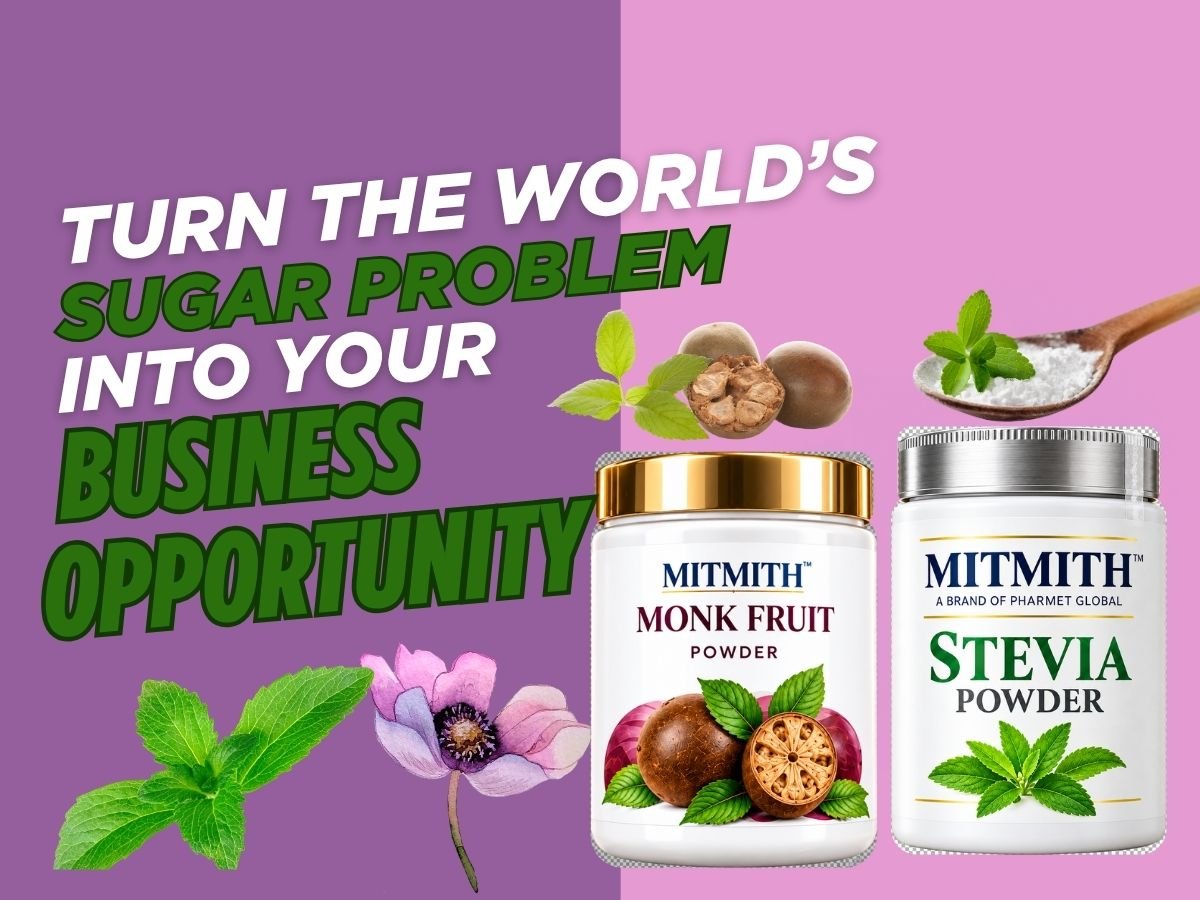
That is why PHARMET GLOBAL has included both in its MITMITH range for export from India. A natural monk fruit sweetener sits alongside high-purity stevia, giving importers a complete plant-based sweetening portfolio from a single, accountable source. For premium retail buyers who ask for an organic monk fruit sweetener, we will always state plainly which grades carry certification and supply the certificate with the consignment. It is the kind of range a serious monk fruit distributor can build a brand on.
One honest note: monk fruit regulations differ by country. It is well accepted in the United States and much of Asia, while the European Union has not yet authorised the purified extract as a sweetener. We help partners confirm the position in their market before the first order the sort of groundwork every careful monk fruit distributor should insist upon.
The Importer’s Opportunity
Back in Kuwait, Jacob noticed something new at his own customers’ counters. Pharmacists were asking for sugar-free products by name. Mothers were asking which sweetener was safe for the family. Gyms were asking for clean-label protein powders.
He realised that the change he had made at his own breakfast table was happening in millions of homes. Within a year he had added a sweetener line and set up a stevia distributorship serving pharmacies across the country. He now plans to add an organic monk fruit sweetener for the premium segment and expand into a full sweetener distributorship covering both plants.
There is more than one way to enter this market, and it helps to know the difference. A stevia distributorship typically supplies at scale across a territory, moving bulk and private-label stock to retailers and formulators. A stevia dealership usually sits closer to the customer, selling finished packs directly to pharmacies, grocers and gyms. Many partners begin with a focused stevia dealership, prove the demand, and then grow into a broader sweetener distributorship that also carries monk fruit. Whichever route you choose, the role is the same at heart: to be a dependable sugar substitute supplier your customers can rely on.
For any stevia distributorship, the economics are compelling. High intensity sweeteners travel light, store easily and convert into sachets, drops, tablets and private-label packs with margins that commodity sugar cannot approach. A stevia dealership enjoys the same advantage at a smaller footprint, and a monk fruit distributor can command a genuine premium, because clean-tasting monk fruit is still comparatively scarce on many shelves.
Why PHARMET GLOBAL
PHARMET GLOBAL exports pharmaceutical, nutraceutical, cosmeceutical and pet care products from India to importers across Africa, Latin America, the Middle East and South Asia. Our founder brings more than 35 years of first-hand pharmaceutical experience, and we approach a sweetener the way we approach a medicine: defined purity, batch-wise COAs, current halal, kosher and non-GMO documentation, realistic MOQs and lead times we can keep. In short, we aim to be the most dependable sugar substitute supplier our partners work with.
From high-purity stevia to a natural monk fruit sweetener and, where certified, an organic monk fruit sweetener, the MITMITH range is built to give importers a complete plant-based line. Whether you are an established stevia distributorship, a growing stevia dealership, an ambitious monk fruit distributor, or a first-time buyer exploring a full sweetener distributorship, we would like to be your most dependable link to India.
Frequently Asked Questions
Q1. Can stevia or monk fruit reverse diabetes?
No sweetener is a cure. Replacing sugar with stevia or monk fruit lowers sugar and calorie intake, which helps control blood glucose. Combined with diet, activity and medical care, this can slow complications and, in some people with early type 2 diabetes, contribute to remission.
Q2. Is a natural monk fruit sweetener safe for daily use?
Monk fruit extract is widely accepted as safe in markets such as the United States and has a long history of traditional use. Always check the local regulatory position a reliable monk fruit distributor or sugar substitute supplier will help you confirm it before you order.
Q3. What is the difference between a natural and an organic monk fruit sweetener?
“Natural” refers to plant origin. An organic monk fruit sweetener must also be grown and processed under a certified organic standard, with a valid certificate naming the product.
Q4. Why are high intensity sweeteners profitable for importers?
Because so little is needed. One kilogram of extract can replace a couple of hundred kilograms of sugar in sweetness, so freight and storage costs are low and finished formats carry premium margins. For a stevia distributorship or a stevia dealership, that translates directly into healthier profits.
Q5. What should a new stevia distributorship look for in a supplier?
Defined purity grades such as Reb A 97%, batch-specific COAs, current halal and kosher certificates, a trial MOQ, and a sugar substitute supplier who answers when something goes wrong. The same checklist serves a stevia dealership, a monk fruit distributor, or a full sweetener distributorship equally well.
Conclusion: Quitting Sugar Without Quitting Sweetness
Look at where the world is heading and one conclusion is unavoidable: personal health has become the top priority for families everywhere, and nowhere more clearly than in developed countries. In the United States, roughly four in ten adults live with obesity. In the United Kingdom, diabetes care consumes around a tenth of the national health budget. Families who once measured success by income now measure it by energy, eyesight, mobility and years of good life together.
Yet sugar consumption keeps rising, and so do diabetes, obesity and the silent complications that follow them. The answer is not to ask people to give up the pleasure of sweetness. It is to give them a better source of it.
Stevia and monk fruit do exactly that. They are plant-based, calorie-free high intensity sweeteners, kind to blood sugar and teeth. They let people quit sugar without quitting sweetness, and they let importers build a business whether a stevia distributorship, a stevia dealership, a monk fruit distributor operation, or a complete sweetener distributorship on one of the strongest health trends of our time.
Jacob still drinks three glasses of sweet tea a day. The tea is just as sweet. Only the sugar is gone.
To request MITMITH specification sheets, sample COAs and a trial quotation, visit www.pharmetglobal.com.
What Our CEO Shared On YouTube Via A Short Video:
Here’s a link to an interesting YouTube Video on Natural Sweeteners, which we surely hope you will find interesting & informative:
Looking To Source Quality Products From India? Let’s Connect.
Would you like to reach out to us for seamless Export Support For Pharmaceutical, Innovative Nutraceuticals, Cosmeceuticals, Hospital Consumables, Pet Care or any other products from India as per your requirement?
You can easily connect with us Via the following channels:
· E-MAIL: hello@pharmetglobal.com
· WhatsApp/ BOTIM: +91 9999091881
· WEBSITE: https://pharmetglobal.com
· YouTube: https://www.youtube.com/@Pharmet
· Connect With Our CEO On LINKEDIN: https://www.linkedin.com/in/arvinder270265/
Come, connect with us today & let’s deliver: Health, Happiness & Innovation together…Profitably.

Leave a Reply